
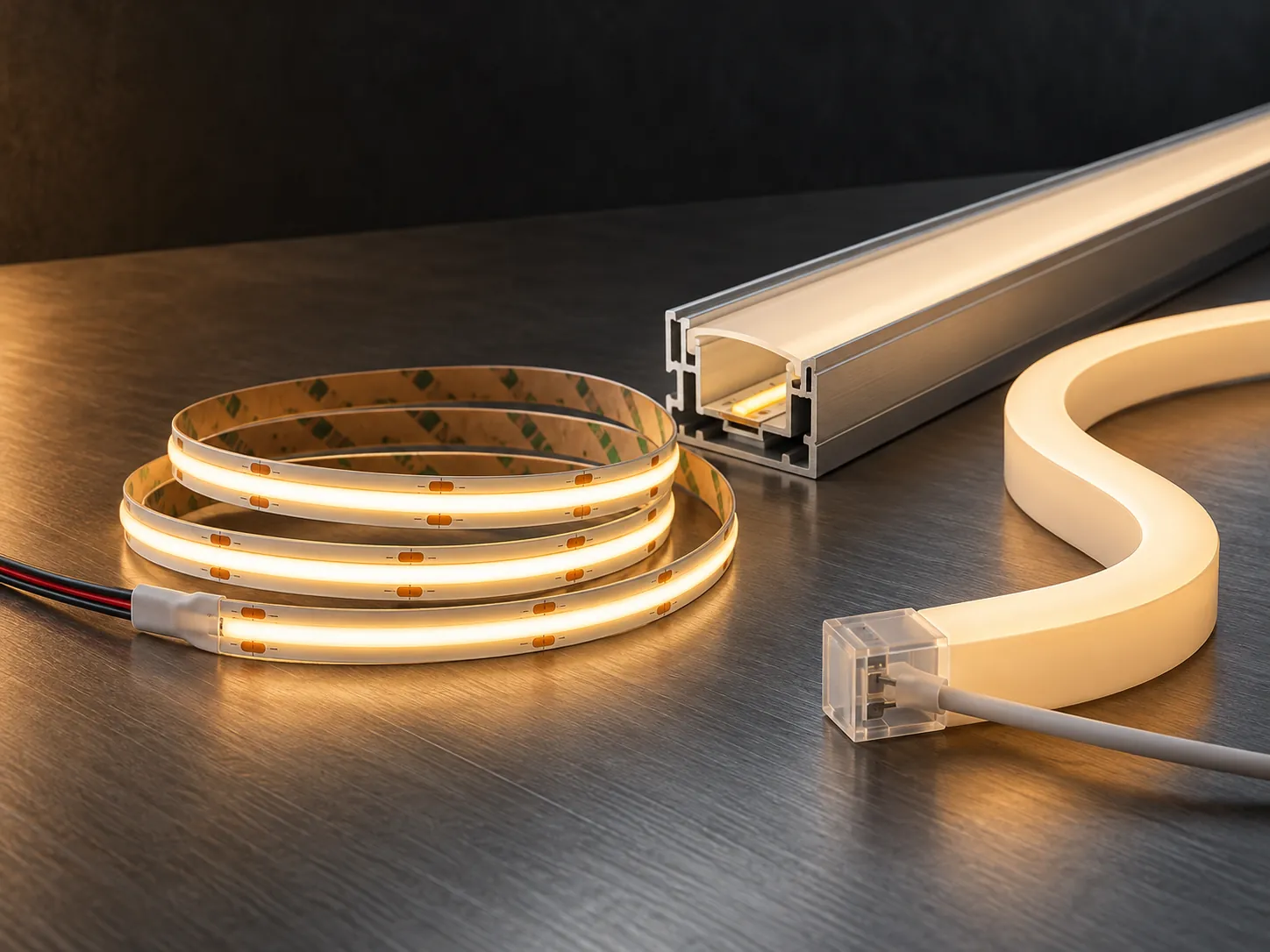
An Engineering & Procurement Technical White Paper for Distributors, Contractors, and Project Buyers.
A wholesale LED strip order is a system decision, not a commodity purchase. The strip, driver, controller, aluminium profile, connectors, and sealing method either work together for years, or fail together in the first season. The failures I see most often are not caused by a bad LED chip. They are caused by a specification that was never written down: a voltage chosen for price, a colour bin never checked, an IP rating trusted without a test report, or a driver sized without headroom. This guide is for the buyer who has to sign that specification: distributors, contractors, and project buyers. Every number here is a typical range from current manufacturer specifications, unless it is stated as a test standard. We manufacture LED strip and linear lighting at Juntor Lights, Shenzhen Juntor Lighting Co., Ltd., established in 2016, with bases in Shenzhen and Fujian covering more than 10,000 m². LED Strip and Linear Lighting is one of our five product systems, alongside automotive, portable and camping, decorative and festive, and outdoor and architectural lighting. We work to ISO 9001, ISO 14001, and ISO 45001, and supply CE, RoHS, REACH, RCM, and UKCA documentation where the destination requires it.
1. Specification at a Glance: Read Any Datasheet in 60 Seconds
1.1 The master specification table
A complete wholesale specification can be read in one table. If a supplier cannot fill every row, the missing row is the risk you are accepting. The ranges below are typical ranges across current manufacturer specifications, not a quotation for any single model.
| Parameter | Typical / Entry | Mid / Commercial | High / Premium |
|---|---|---|---|
| Voltage | 12V DC | 24V DC | 48V DC / 110-230V AC |
| Power | 4.8-7.5 W/m | 10-14.4 W/m | 15-38 W/m |
| Lumens | 300-600 lm/m accent | 500-1,000 lm/m ambient | 1,000-3,000 lm/m task |
| Efficacy | 70-90 lm/W | 90-120 lm/W | 120-150 lm/W |
| LED density | 30-60 /m | 72-120 /m | 120-240 SMD; 300-840 COB |
| CCT | 2700-3000K warm | 3500-4500K neutral | 5000-6500K cool; tunable 2700-6500K |
| CRI / Ra | 80+ | 90+ | 95-98 |
| SDCM | <5 | <3 | <3, CCT ±50K per bin |
| Cut length | 50-100 mm | 25-50 mm | 10-25 mm |
| PCB width | 5-8 mm | 8-10 mm | 10-12 mm |
| Copper | 1 oz (35 µm) | 2 oz (70 µm) | 3 oz (105 µm) |
| IP | IP20 dry indoor | IP65 jets / IP67 1 m / 30 min | IP68 continuous, supplier-defined |
| Beam angle | 120° SMD | 160-170° CSP | 180° COB |
| Lifespan (L70) | 25,000-30,000 h | 30,000-50,000 h | 50,000 h (LM-80 / TM-21) |
| Operating temperature | -20 to +40°C | -20 to +50°C | -25 to +60°C, varies by model |
| Warranty | 3 years | 3-5 years | 5-7 years, selected models |
Read the table from the application outward, not from the price inward.
1.2 How to read a datasheet, and what a missing line means
A datasheet should state voltage, power and lumens per metre, efficacy, CCT, CRI, SDCM, cut length, PCB width and copper weight, IP rating with the test standard, operating temperature, lifespan with the L70 definition, and the applicable certificates. It should also state the test conditions: the voltage at which power was measured, the temperature at which flux was measured, and whether the lumen figure is for the bare strip or for the strip inside a diffuser. A missing SDCM line means colour consistency was not controlled, a missing copper weight means voltage drop was not engineered, and a missing IP test standard means the IP number is a claim, not a result. Ask for the missing line in writing before you pay a deposit.
1.3 Application matrix: accent, ambient, task, signage, outdoor, and OEM
Accent lighting needs low brightness, warm colour, and a clean line. Ambient lighting needs even output and stable colour across a long run. Task lighting needs high lumens per metre, high CRI, and a heat path that keeps the strip cool. Signage needs a defined IP rating, a sealed joint system, and a driver that can be serviced.
2. Strip Architecture: SMD, COB, CSP, and Neon Flex
Outdoor work needs UV-proof encapsulation at the joints, and OEM work needs batch traceability.
2.1 SMD, the cost-first workhorse
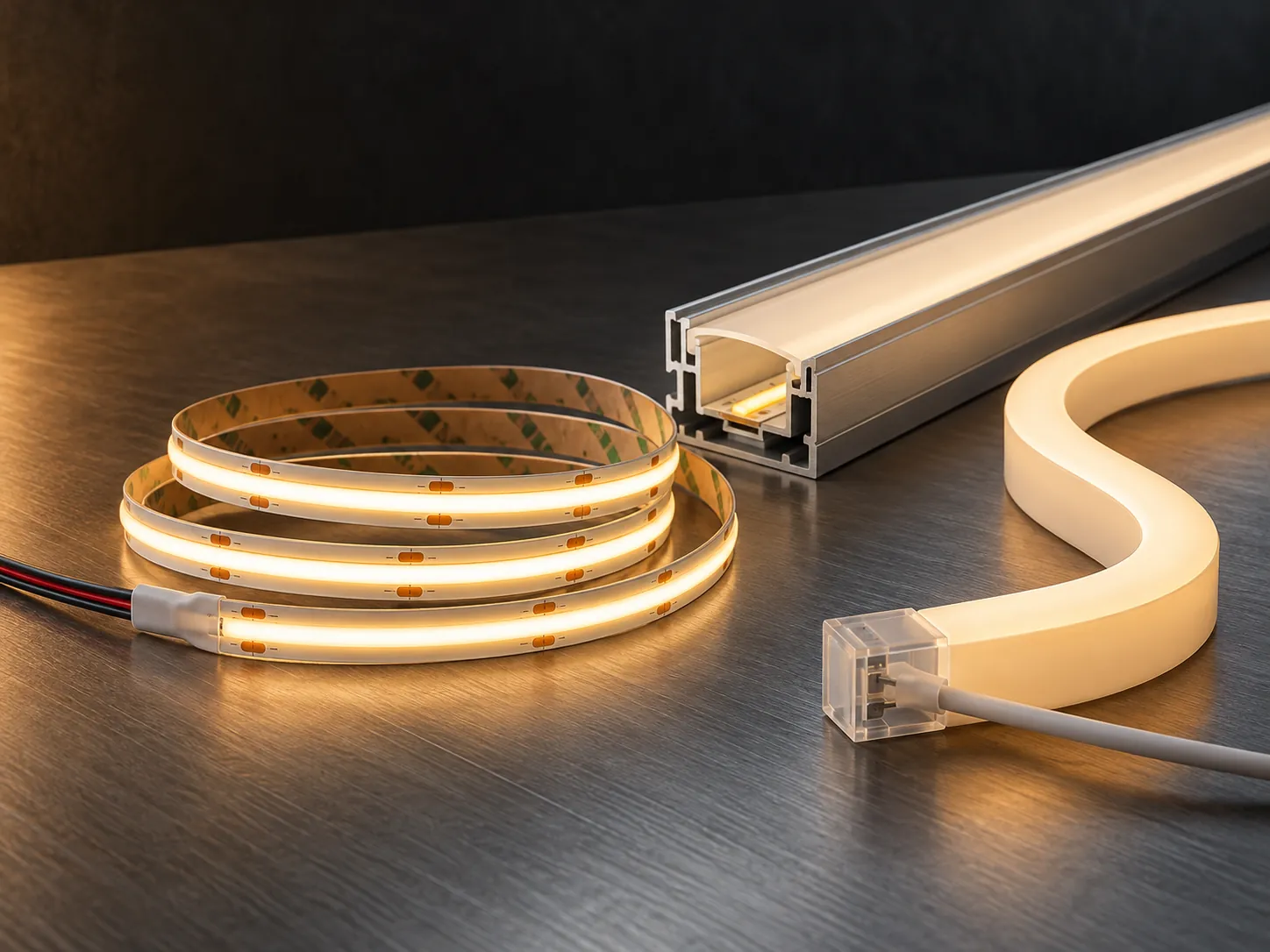
Surface-mounted device strips use discrete LED packages, most commonly 2835, 5050, 3528, and 2216. Density typically runs from 30 to 120 LEDs/m, power from 4.8 to 28.8 W/m, and beam angle is 120°. SMD is the right choice when the strip is hidden behind a diffuser, inside a channel, or under a cabinet, and when cost per metre matters more than a visible dot-free line. With a good diffuser, an SMD strip at 120 LEDs/m can look continuous from a normal viewing distance.
Without a diffuser, the individual points remain visible.
2.2 COB, the dot-free architectural line
Chip-on-board strips pack the chips so densely that the light line appears continuous. Equivalent density is commonly quoted at 240 to 528 LEDs/m, with chip counts in listings reaching 360 to 840 chips/m. The beam angle widens to 180°, which suits cove lighting, wall washing, and retail displays where the strip itself is visible. Power is typically 4 to 14 W/m, and the upfront price is commonly 20-40% higher than an equivalent SMD strip.
That premium buys the visible line, not a longer life, because dense packing concentrates heat without a profile.
2.3 CSP and neon flex, tight bends and sealed silicone bodies
Chip-scale package strips use flip-chip construction with a beam angle of 160-170° and a bend radius as tight as 10-15 mm. They suit curved coves, tight corners, and high-density flexible runs where SMD cannot bend far enough and COB is too stiff. Neon flex is a strip sealed inside a silicone body that produces a continuous neon-like line. It is commonly supplied in 12V or 24V DC, with 230V AC versions for long runs.
A 230V AC neon flex must never be cut in the field unless the manufacturer allows it, and only at the marked points.
2.4 Comparison table, and which architecture fits which job
| SMD 2835 / 5050 | COB | CSP | |
|---|---|---|---|
| Light line | Visible dots without deep diffuser | Dot-free, continuous | Near dot-free, faint at close range |
| Beam angle | 120° | 180° | 160-170° |
| Density | 30-120 LEDs/m | 240-528 LEDs/m equivalent | High, flip-chip |
| Power | 4.8-28.8 W/m | 4-14 W/m typical | Mid to high |
| Efficacy | 80-120 lm/W | See Section 4.4, heat-density caveat | Mid-range |
| Bend radius | 25-30 mm | 20-25 mm | 10-15 mm |
| L70 lifespan | 30,000-50,000 h | 50,000+ h with a heat path | 35,000-50,000 h |
| Upfront cost | Lowest | +20-40% vs SMD | Premium / specialist |
| Best for | Hidden / functional, non-visible | Visible architectural, cove, retail | Tight curves, high-density flexible |
Choose SMD with a diffuser when the strip is hidden and the budget is tight.
3. Electrical Specifications: Voltage, Power, and Voltage Drop
3.1 12V vs 24V vs 48V, current, feed distance, and the 1/V² rule
Voltage does not change brightness or power by itself. It changes current, and current changes voltage drop, cable thickness, and the number of feed points. At the same power, doubling the voltage halves the current. Percentage voltage drop follows the 1/V² rule: percentage drop equals 2 × P × R / V², where P is power, R is resistance, and V is voltage.
| Voltage | Current / m at 14.4 W/m | Typical max run, one-end feed | Supplies for 20 m |
|---|---|---|---|
| 12V | 1.2 A | ~5 m | 4-5 |
| 24V | 0.6 A | ~10 m | 2-3 |
| 48V | 0.3 A | 20 m+ | 1-2 |
| Constant-current 24V | Compensated by driver IC | 15-50 m | 1-2 |
| High-voltage AC 110-230V | Mains rules apply | Up to 50 m | 1 |
The table is based on 14.4 W/m, 60 LEDs/m, and a target of less than 10% drop. Change the power, density, or copper weight, and the run length changes with it.
Use 12V for short runs, 24V as the commercial default, and 48V for long runs.
3.2 Wattage per metre and total load, the sizing arithmetic
Total load is simple arithmetic, and it must be done before the driver is ordered. Total watts equal watts per metre multiplied by total metres. A 5 m run at 14.4 W/m draws 72 W. A 20 m run at the same power draws 288 W.
Do not select by wattage alone: equal watts can give different lumens and colour.
3.3 Voltage drop and maximum run, 5 m, 10 m, and 20 m bands, wire gauge, and PCB copper
Voltage drop is the gradual fall in voltage along the strip. A 12V strip fed from one end can fall to 9.01V after 5 m, a drop of nearly 3V. Once the drop exceeds 5%, the loss of current and brightness becomes visible, and white light shifts toward yellow and then red as the voltage falls further. Three factors control the drop: current, run length, and resistance.
12 AWG is about 5.2 mΩ/m, 2 oz copper is 70 µm, 3 oz is 105 µm, with bands of 5 m at 12V, 10 m at 24V, and 20 m+ at 48V.
3.4 Constant-voltage vs constant-current strips
Most wholesale strip is constant-voltage: the driver holds the voltage, and each section draws the current it needs. It is simple, widely available, and compatible with the largest range of dimmers and controllers. Its weakness is that voltage drop along the run is not compensated, so brightness falls with distance. Constant-current strip uses a driver IC on the strip to hold the current steady, compensates for voltage drop, and can sustain runs of 15 to 50 m from a single feed, depending on the design.
4. Light Quality: Lumens, Colour Temperature, CRI, and Consistency
Use constant-current when feed points are impossible or uniformity must hold over a long run.
4.1 Lumens per metre by application
Compare strips by lumens per metre, not by watts. Accent lighting typically needs 300-600 lm/m, and in some guides 200-500 lm/m is enough for a subtle line. Ambient and general lighting typically needs 500-1,000 lm/m. Task lighting typically needs 1,000-1,500 lm/m or more, and industrial and signage work can need 1,500-3,000 lm/m.
A diffuser cuts output slightly, so specify lumens at the finished installation.
4.2 CCT, 2700K to 6500K, tunable white, and dim-to-warm
Colour temperature is measured in kelvin. Warm white is 2700-3000K. Neutral white is 3500-4500K. Cool white and daylight are 5000-6500K.
Tunable white covers 2700-6500K, dim-to-warm falls toward 1800K, and both need a compatible controller.
4.3 CRI, R9, TM-30, and SDCM, why the same 3000K can look different across reels
Colour rendering index, or CRI, measures how accurately a light source renders colours compared with a reference source. A CRI of 80-89 is good for general use. A CRI of 90-95 is outstanding and is the minimum for retail, food, art, and finishes, where colour accuracy is the product. A CRI of 95-99 is extraordinary and is used where the eye must judge colour precisely.
R9 covers saturated red, TM-30 adds fidelity and gamut, and SDCM <3 is the tighter tolerance, so ship a single bin per visible run.
4.4 Efficacy in lumens per watt, and the heat-density caveat on COB efficacy claims
Efficacy measures how much light you receive for each watt consumed. Typical SMD 2835 efficacy is 90-120 lm/W. Typical 5050 efficacy is 80-100 lm/W. COB efficacy is quoted in the market in two conflicting ranges: 80-110 lm/W in some sources, and 100-150 lm/W in others.
5. Protection, Materials, and Durability
The gap comes from heat density: dense COB packing lowers efficacy unless heat escapes, so any claim above 120 lm/W needs a stated test temperature and profile.
5.1 IP ratings under IEC 60529, IP20 to IP68, with the IP65, IP67, and IP68 table
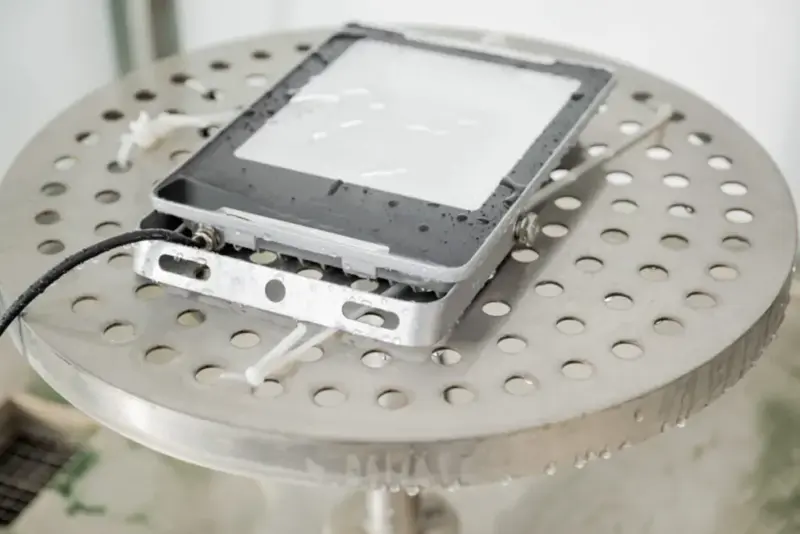
The IP code under IEC 60529 has two digits. The first measures protection against solids. The second measures protection against liquids, and it is the digit that decides the purchase. An IP rating is not a ranking of overall quality.
| Rating | Liquid test | Construction | Use | Limit |
|---|---|---|---|---|
| IP20 | None | Bare PCB | Dry indoor only | No water or dust protection |
| IP44 | Splashes | Light coating | Damp indoor, Zone 3 | Not jets or immersion |
| IP54 | Splashes, dust-limited | Coating | Covered outdoor, kitchens | Not jets or immersion |
| IP65 | Water jets 12.5 L/min, 3 min | Silicone or epoxy coating | Covered outdoor, damp indoor | Zero submersion |
| IP67 | Immersion 1 m, 30 min | Silicone sleeve / injected silicone | Exposed signage, facade, garden | Short-term dunking only |
| IP68 | Continuous immersion above 1 m | Fully injected silicone, resin-potted ends | Pools, ponds, fountains, marine | Depth and time supplier-defined |
Use IP20 only where the strip will stay dry and clean. Use IP65 where it will face splashes and water jets but never stand in water.
IP68 depth and time are supplier-defined, so write them into the RFQ.
5.2 The weakest-joint rule, field cuts, connectors, and end seals
A waterproof strip is only as waterproof as its weakest joint. The strip body can pass IP68, and the system can still fail at a cut end, a splice, a connector, or an end cap. Most water-ingress failures we investigate are at those joints, not in the middle of a sealed strip. A field cut voids the factory seal unless the cut is resealed to the same standard as the factory seal.
Resin-potted end caps are most reliable, followed by adhesive-lined heat-shrink with neutral-cure silicone, then IP-rated junction boxes with glands.
5.3 PCB, copper, and encapsulation, 1-3 oz copper, silicone vs PVC vs TPU
The printed circuit board carries the current, the heat, and the mechanical load. PCB width is commonly 5-12 mm, with 8 mm and 10 mm the most common for commercial work. Copper weight is stated in ounces per square foot. 1 oz copper is 35 µm thick.
2 oz is 70 µm and typical, 3 oz is 105 µm for long runs, silicone suits IP65-68, PVC yellows, and TPU is best for submerged work.
5.4 Lifespan, L70, LM-80 and TM-21, and temperature rise
Lifespan for LED strip is defined by L70, the point at which light output has fallen to 70% of its initial flux. L70 is not the point at which the strip fails. It is the point at which the light is judged to have degraded enough to matter. Nominal lifespan is commonly quoted at 25,000-50,000 hours, with 50,000 hours the usual premium claim.
6. The Complete System: Driver, Dimming, Control, and Wiring
LM-80, typically 6,000 hours, with TM-21 projection defines L70, and temperature rise should stay at or below 40°C.
6.1 System single-line diagram
A strip is one part of a system. The mains supply feeds a driver, the driver feeds a controller or decoder where dimming or colour control is needed, and the controller feeds the strip. Power injection points and feed points are part of the design, not an afterthought. The diagram below shows the normal chain for a low-voltage commercial installation.
System layout: AC supply → compatible LED driver → controller (where required) → LED strip. Feed additional runs through correctly sized parallel wiring; confirm all voltage and current ratings.
If any link changes after ordering, recheck voltage, current, protocol, and power.
6.2 Driver sizing, the 80% rule, worked example, and Class 2 limits
Size the driver by the total load, then add headroom. Total load equals watts per metre multiplied by total metres. A 5 m run at 10 W/m draws 50 W. Under the 80% rule, the driver must be rated at 50 W ÷ 0.80, which is 62.5 W, so select a driver rated at least 62.5 W, such as a suitable 75 W model, after checking its temperature derating.
Headroom is +20-25%, the driver must match voltage, type, protocol, and IP rating, and Class 2 limits need a qualified electrician.
6.3 Dimming, PWM, 0-10V, DALI, DMX512, and TRIAC, the two-layer model
Dimming has two layers, and they must not be confused. The control layer is the signal that tells the driver what to do. The output layer is the switching that actually dims the strip. A 24V strip never sees the wall dimmer directly.
TRIAC suits retrofits, 0-10V is the commercial default, DALI addresses 64 devices per bus, DMX512 suits dynamic colour, and a PWM dimmer does not work with a 0-10V driver.
6.4 Wiring, connectors, and power injection
Wiring is where a good specification becomes a good installation or a failed one. Use a wire gauge that keeps the voltage drop below 5% at the full load, and use the wire chart for the gauge, length, and load, not a guess. Feed a long run from the middle or from both ends where the layout allows it, and inject power at intervals where the run exceeds the single-feed band for its voltage. A power injection point is a separate feed from the driver or from a distribution point to a point further along the strip, not a continuation of the strip itself.
7. Sizing, Cost, and Return: The Total Installed Cost
Connectors must match width, pin count, and IP rating, never mount on bare metal, and never power a strip while coiled on the reel.
7.1 Power calculation, worked example, metres multiplied by watts per metre, plus 20-25% headroom
Work the power calculation in the open, on the RFQ, so that supplier and buyer are sizing the same system. Take a retail shelf run of 20 m at 14.4 W/m. The strip load is 20 × 14.4, which is 288 W. Add 25% headroom, and the driver capacity needed is 360 W.
7.2 Price per metre by tier, and what a low per-metre price omits
Strip-only prices are commonly quoted in planning ranges, not as fixed quotations, because density, CRI, copper, encapsulation, and volume change the price. A typical planning range is $1.50-$5 per metre for standard indoor SMD strip, $3-$10 per metre for COB strip, $3-$12 per metre for finished products, and $5-$20 per metre for specialty and sealed strip, including high-CRI and waterproof types. These figures are planning ranges for budgeting, not Juntor quotations. A firm price can only be given against a written specification, a quantity, and a destination.
A low per-metre price usually omits something, such as thinner copper, wider SDCM, lower CRI, a shorter warranty, or a missing driver.
7.3 Total installed cost vs strip-only cost, driver, profile, diffuser, connectors, freight, duties, and rework
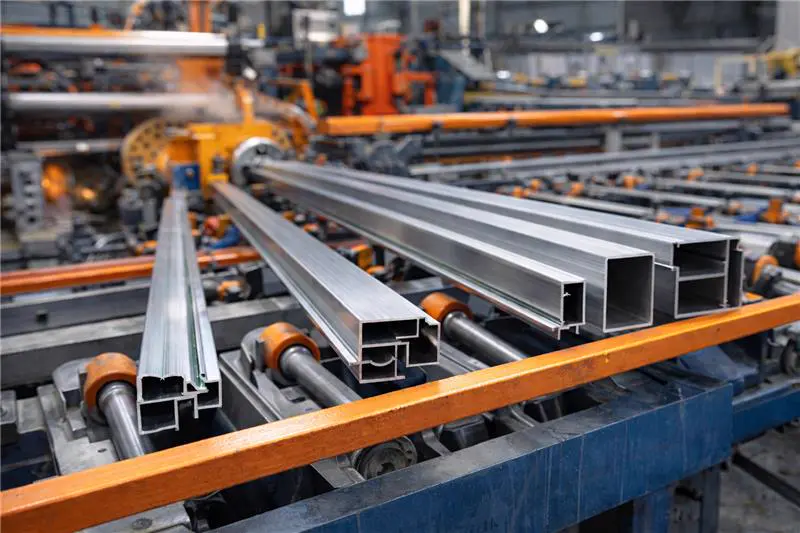
The strip is often the smallest part of the installed cost. The driver, aluminium profile, diffuser, connectors, controller, wiring, freight, duties, and installation labour together commonly exceed the strip cost by a large margin. A profile that doubles or triples the life of the strip by carrying heat away is not an accessory. It is part of the lifetime cost.
7.4 ROI and lifecycle, labour is 5-10 times strip cost, a failed strip pays for installation twice
Return on investment for LED strip is not measured in the price per metre. It is measured in the cost of the light over its life, including the labour to install it and the labour to replace it. Installation labour is commonly 5-10 times the strip cost for a professional job, once access, profile mounting, wiring, and commissioning are counted. A strip that fails early does not cost the price of the strip.
💡 Procurement Cost-Saving Calculator Available
Planning a wholesale order and want to see the full installed cost before you commit? Request our procurement cost-saving calculator and send your total metres, watts per metre, voltage, and destination. Our engineering team will return a worked calculation showing strip, driver, profile, controller, freight, and headroom, so you can compare offers on the same total cost. Contact our team through contact our engineering team and mention the calculator in your message.
8. Wholesale Procurement: MOQ, Samples, Lead Time, AQL, and the RFQ
A 3-year warranty is a minimum, 3-5 years is normal, so ask how claims, freight, and replacement times work.
8.1 MOQ, samples, and lead time, trial, standard, and custom tiers
Minimum order quantity, sample policy, and lead time vary widely by supplier and by customisation, and they must be presented as ranges with the conditions that move them. The table below summarises the ranges found across current manufacturer terms. It is a planning guide, not a quotation, and the exact terms for an order must be confirmed in writing against the specification.
| Item | Low / Trial | Standard | Custom / OEM |
|---|---|---|---|
| MOQ, standard strip | 1 reel / 50 m; 1 m standard flexible | 50-100 reels / 500 m COB | 100-1,000 m custom; 2,000 m custom COB |
| Sample | 1 reel / 1 piece | 3-7 days, $30-70 per model, refundable | Sample approval before mass production |
| Lead time, stock | 24-48 h dispatch; 3-5 days | 10-15 days standard bulk | Not applicable |
| Lead time, custom / OEM | 7-15 days custom lengths, waterproof | 15-20 days OEM; 15-25 days custom, private label | 18-22 days; 3-5 weeks custom moulds |
| Price planning, strip only, USD/m | $1.50-$5 standard indoor SMD | $3-$10 COB; $3-$12 finished | $5-$20 specialty, sealed; $4-$15 high-CRI |
Order a sample and test it in the intended installation before you pay for bulk production. Test the brightness, colour, CRI, dimming behaviour at the lowest level, cut points, adhesive or profile fit, and end seals.
Agree sample approval, batch traceability, and repeat-order procedure before the deposit, because partnerships fail on the fourth or fifth batch, when the specification drifts.
8.2 Quality inspection, AQL 0.65, 1.0, and 1.5 by defect class, aging and burn-in, LM-79 and LM-80 reports, and batch traceability
Quality inspection must be agreed before the deposit, not after the goods arrive. AQL, the acceptable quality level, is quoted by defect class, and the levels differ by supplier. A common structure is AQL 0.65 for critical defects, such as electrical safety, flicker, and missing solder, and AQL 1.5 for cosmetic defects, with a tighter AQL 0.4 for critical and AQL 1.0 for cosmetic on request for project orders. Another common structure is AQL 1.0 per production batch for photometric inspection, with flux within ±5%, CCT within ±2 steps, and CRI at or above the specified value.
Common practice is 100% aging for 2-4 hours, with LM-79 and LM-80 reports and batch numbers on every reel.
8.3 Certifications by destination, CE and RoHS for the EU, UL and ETL for North America, UKCA, and RCM, model-specific certificates, not logos
Certification is destination-specific and model-specific. For the European Union, the usual documents are CE under the Low Voltage Directive and EMC Directive, RoHS, and REACH, with EN IEC 62031, IEC TR 62778, and EN 62471 cited where they apply. For North America, the usual documents are UL or ETL, with UL 8750 and UL 2108 as the relevant contexts for LED strip and low-voltage lighting systems. For the United Kingdom, the document is UKCA.
🛠️ Engineering Tender Support
Preparing an RFQ or a tender submission and need the engineering documents to go with it? Request our engineering tender support and send your project brief, total length, voltage, colour, CRI, IP rating, and destination. Our engineering team will return single-line drawings and a container loading plan for your order, so your tender can be priced and installed with confidence. Contact our team through contact our engineering team and mention tender support in your message.
UKCA covers the United Kingdom, RCM covers Australia and New Zealand, and reports should come from Intertek, TÜV Rheinland, SGS, or Bureau Veritas.
8.4 The 7 buyer pitfalls and the pre-payment RFQ checklist
- Buying by watts only. Watts measure power, not light. Specify lumens per metre, CCT, and CRI as well.
- Ignoring voltage and run length. A long run fed from one end will drop in voltage, brightness, and colour. Specify the voltage, the maximum run, and the feed points.
- Trusting the word waterproof alone. Specify the IP number, the IEC 60529 test, the depth and time for IP68, and the end-seal method.
- Forgetting the driver or undersizing it. Specify the driver voltage, type, dimming protocol, and headroom of +20-25%.
- Choosing RGB when white light matters. RGB cannot make a pure white. Specify RGBW or tunable white where white light is the job.
- Ignoring CRI and binning for displays, food, and finishes. Specify CRI 90+ and SDCM <3 for colour-critical work, and a single bin per visible run.
- Sending a vague RFQ and skipping sample approval. Specify the model, the batch, the driver, and the documents, and approve the sample in writing before mass production.
Before you pay a deposit, send an RFQ stating the use case, strip model, voltage, total length, colour, CCT, CRI, SDCM, IP rating, control protocol, driver, quantity, destination, and the documents you require, including LM-79, LM-80, IP test, certificates, and warranty terms.
To discuss your specification, request a quotation, or send a sample request, contact Juntor Lights through contact our engineering team or on WhatsApp at +86 156 5950 9975. Send the application, the total length, the voltage, the colour and CRI, the IP rating, and the destination, and our engineering team will confirm the specification and the next step.
Frequently Asked Questions
1. What MOQ should I expect for wholesale LED strip lights?
It depends on the product and the level of customisation. Standard flexible strip can start at 1 reel / 50 m, or 1 m for standard flexible strip, while custom and OEM orders commonly run from 100 to 1,000 m, and custom COB can reach 2,000 m. Always confirm the MOQ, sample policy, and lead time in writing against your specification before paying a deposit.
2. Which voltage should I choose, 12V, 24V, or 48V?
Use 12V for short, low-power runs where the driver is close to the strip. Use 24V as the commercial default, with a typical maximum run of about 10 m from a one-end feed. Use 48V for long runs and facades, with typical runs of 20 m and beyond, because the higher voltage halves the current at each step and cuts percentage voltage drop sharply.
3. How do I verify IP68 and CRI claims before ordering?
Ask for the IEC 60529 test report stating the IP68 depth and duration, because those values are supplier-defined, and ask for the LM-79 report for the model, including CRI and flux. Approve a sample in the intended installation, check the end seals, and require a single colour bin per visible run, with the bin and batch number on the reel and on the packing list.